


In any fleet operating in Saudi Arabia’s big cities, time and fuel are the two largest daily costs. A driver who chooses a route half an hour longer every day, or a vehicle that returns empty from its trip, means a loss that accumulates over the month. This is where route optimization comes in: a method that uses data and algorithms to choose the best order of stops and the most suitable road for each vehicle. In this guide we explain how it works, when it helps, and how to apply it to your fleet step by step.
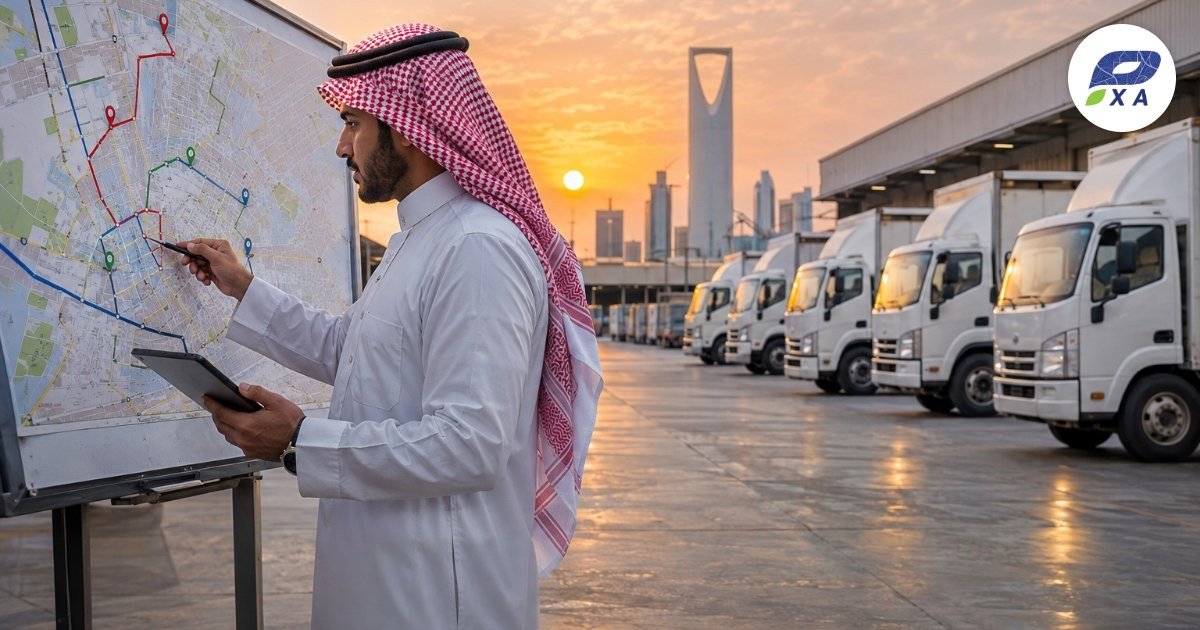
What is route optimization?
It is the process of determining the best sequence of visits and the most suitable route between points, taking real constraints into account: customer appointments, vehicle capacity, driver working hours and traffic. It does not just mean “the shortest road”, because the shortest in distance may be the slowest in time or the most expensive. The goal is to finish the work in the least time and fuel with the highest on-time performance.
Why does it matter for your fleet?
- Less fuel: reducing unnecessary distance, stopping and waiting shows directly in consumption, and you can follow the effect in fuel consumption monitoring.
- Better on-time performance: arrival estimates are more accurate, so late orders and customer complaints drop.
- More done with the same vehicles: when visits are ordered smartly, a vehicle absorbs more tasks.
- Less pressure on drivers: a clear plan reduces individual improvisation and unorganized trips.
- Data-based decisions: reports show where time is lost: traffic, waiting at the customer, or poor task ordering.
Static route versus dynamic route
| Criterion | Static route | Dynamic route |
|---|---|---|
| Planning method | A schedule prepared in advance that repeats | Updated according to conditions and new requests |
| Suitable for | Repeated routes (staff transport, periodic distribution) | Order delivery and field services |
| Handling congestion | Limited | Recalculates when conditions change |
| Operating complexity | Simple | Needs a smart platform and live data |
Many fleets combine both: fixed core routes with live adjustment for emergencies or urgent requests.
How does a route optimization system work?
1. Collecting inputs: the list of destinations, each vehicle’s capacity, working hours, required delivery windows and the vehicles’ current status.
2. Understanding reality: live tracking data, actual vehicle positions and past trip history, which makes relying on the intelligent vehicle tracking and monitoring system the base of any real optimization.
3. Calculation: algorithms compare thousands of possibilities for ordering visits and choose the best distribution for your goal: least distance, least time or least cost.
4. Execution and follow-up: the route reaches the driver’s phone and management follows execution against the plan.
5. Learning: comparing the plan with reality reveals causes of delay, so future plans improve. You can read more about the role of artificial intelligence in AI vehicle tracking systems.
Want us to analyze your fleet’s routes and show you where time and fuel are lost? Contact the Pixa team.
Request a route analysis of your fleet
Factors that affect routes in Saudi cities
Any excellent system must respect the specifics of operations here:
- Peak hours in big cities, where the actual time of the same road differs between morning and evening.
- Summer heat and its effect on sensitive shipments and on stop and waiting time.
- Prayer times and temporary closures at some customers, which affect delivery windows.
- Long distances between cities and the need to plan stops, rest and refueling.
- Address diversity and the difficulty of some addresses, which needs precise location and confirmation with the customer.
Indicators to measure route optimization success
- Total distance per vehicle per day and how it changed after applying the plan.
- On-time delivery rate.
- Number of visits per vehicle per day.
- Waiting and stopping time at customers and in the warehouse.
- Fuel consumption per trip.
Compare these indicators before and after, over a long enough period, and do not judge from a single day.
Common mistakes
- Relying on a general map only, without linking it to actual vehicle positions and operating status.
- Ignoring fleet constraints: load capacity, vehicle type, or permits to enter some areas.
- Imposing a route without explaining it to the driver: they will ignore it. Involve them and show the benefit.
- Not reviewing results: every month review the reasons for deviation from the plan and adjust.
- Optimizing distance only: sometimes the fastest in time is better than the shortest in distance.
Linking route optimization with driver behavior and maintenance
The best route does not succeed if the driver speeds or stops for long without reason. So link planning to driver behavior monitoring to understand why plans deviate, and review the fleet management system guide for the full picture. If your business is last-mile delivery, see the smart logistics platform for last-mile delivery.
How to start: a four-stage plan
Stage one (a week): make sure there is reliable tracking on every vehicle and a clear trip history.
Stage two (two weeks): analyze current trips: distances, stops and waiting, and identify the worst routes.
Stage three: apply optimization to a pilot group of vehicles and compare with the others.
Stage four: roll out to the fleet after tuning settings and training drivers and supervisors.
These durations are indicative for illustration and vary by fleet size and activity.
Illustrative example: a delivery fleet in a big city
This is a hypothetical example for illustration only: a distribution company where each driver arranges their visits every morning by experience. After analyzing trip history it becomes clear that some drivers cross the same area twice a day, and that one vehicle waits a long time at a single customer while a nearby vehicle has finished its work. After applying central planning, orders are distributed by vehicle proximity and capacity, visits are ordered to avoid repetition, and management is alerted when a vehicle falls behind the plan so it can redistribute. Note that the improvement came from better decision ordering before any change in vehicles or drivers.
Questions to ask an optimization system provider
- Does the system use live vehicle positions, or plan only in theory?
- Does it support my constraints: delivery windows, vehicle capacity, driver hours, vehicle types?
- Does it replan when an urgent request arrives or congestion occurs?
- How does the route reach the driver, and is the app simple and in Arabic?
- Which reports compare the plan with actual execution?
- Does it connect to my order or warehouse system, and how?
- Who supports me technically and how fast do they respond?
Optimization for specialized fleets
Some activities need extra considerations: refrigerated vehicles need trip duration and temperature to be respected, heavy transport needs to respect load and permitted roads, and field-service vehicles need scheduling by skill and location. This is where a flexible platform that adapts to your activity shows its value, and our article on refrigerated truck temperature monitoring has useful details on this side.
Route optimization and regulatory compliance
If your fleet carries goods or passengers, make sure planning respects the regulators’ requirements and permitted driving hours, and check the Transport General Authority’s official site for current regulations. You can learn about linking with its platforms in integrating tracking devices with TGA platforms.
Summary
Route optimization is not a luxury for large fleets only, but a practical tool for any fleet that wants to cut cost and raise on-time performance. Start with accurate tracking, then analyze the reality of your routes, then apply optimization gradually. To learn about Pixa’s integrated solution see the AI-powered smart route optimization system.
Quick summary of route optimization
- In short, route optimization is an operational decision that needs clear criteria before rollout.
- Everything above about route optimization depends on your activity and fleet size.
- Start with a small pilot of route optimization, then expand after measuring results.
- Ask any provider for a live demo that shows route optimization on your own vehicles.
- Document the results of route optimization every month and compare them with your goals.
- The Pixa team can help you with route optimization from planning to operation.
- The best route optimization results come from accurate data and a trained team.
What is the difference between route optimization and ordinary navigation?
Ordinary navigation guides one driver to one destination, while route optimization plans several destinations and several vehicles together according to operating constraints and chooses the best distribution of tasks.
Is it suitable for small fleets?
Yes, even a fleet of a few vehicles benefits if visits are many and changing, but the benefit grows with the number of destinations and vehicles.
Do I need tracking devices to apply route optimization?
Highly recommended, because actual vehicle positions and trip history are the basis of the plan and of measuring compliance with it.
Does it really reduce costs?
It usually helps cut distances and time and therefore fuel, but results depend on your activity and data quality, and are measured by comparing before and after.
How long until results show?
Early indicators appear within weeks of organized application, but a more accurate judgment needs a long enough period covering different peak times.